American Mahjong Rules: The Basics Every Beginner Needs
American mahjong has a lot of rules, but they all revolve around one simple goal: build your 13-draw starting hand into a 14-tile winning hand that matches a line on the current year’s NMJL card. This page lays out every rule you will use in your first ten games, organized by the order you encounter them during a single hand. Bookmark this and keep it open next to your rack.
Players, Equipment and Getting Started
American mahjong is designed for exactly four players sitting around a square table. The standard seat positions are East (starting dealer), South (East’s right), West (directly opposite East), and North (East’s left). These compass directions matter for passing directions in the Charleston and for determining the wall to break with dice.
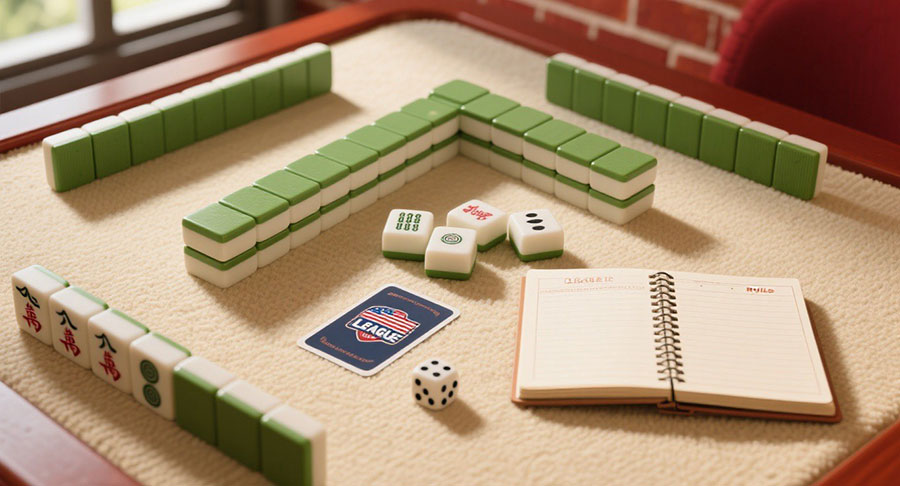
You need six pieces of equipment: an American mahjong set with 152 tiles, four tile racks with built-in pushers, two standard six-sided dice, the current year’s NMJL card, a scorepad, and preferably a mahjong mat. Mats are not strictly required but they protect wood tables and keep tiles from sliding during the wall-building ritual.
The tile set breaks down as follows: 108 suit tiles (36 craks, 36 dots, 36 bams), 16 wind tiles (four of each direction), 12 dragon tiles (four of each color — red, green, white), eight flower tiles representing the four seasons in two copies each, and eight jokers. Each physical tile appears exactly four times in the set — four one-craks, four east winds, four red dragons, etc.
Building Walls and Dealing the Tiles
After washing all 152 tiles face-down in the center of the table, each player builds their own wall in front of their rack. A correct wall is exactly 19 stacks long, two tiles high — 19 times 2 equals 38 tiles per player, times 4 players equals 152. Every tile must be used. If anyone has an extra or is short, stop and rebuild before dealing.
East rolls both dice to determine which wall breaks. Count the total clockwise from East’s own position: 1 means break East’s wall, 2 means break South’s, 3 means break West’s, 4 means break North’s, and repeat the count if the total is over 4 (a roll of 8 means 8 minus 4 equals 4, so break North’s wall).
On the chosen wall, count that many stacks from East’s left end and push the break rightward. Deal begins from the left of the break. East deals four tiles at a time to each player, going first to East themselves, then South (right of East), then West, then North. After three full rounds everyone has 12 tiles.
East then takes two additional tiles — one from each end of the wall break. Every other player takes one tile from the left end of the break. East ends the deal with 14 tiles, everyone else with 13. This extra tile for East compensates for the responsibility of dealing and for starting the Charleston with more information.
The Charleston — Mandatory Passes Before Play
Every American mahjong hand begins with the Charleston: six consecutive passes of three tiles each, designed to give everyone a fair starting hand. The first three passes are mandatory — no one may opt out. The second three are optional — everyone at the table must agree to continue, or the Charleston stops early.
Pass one: every player picks exactly three tiles from their rack and passes them to the player on their right. You may pass any tiles except jokers — passing a joker deadens your hand because you cannot call discarded jokers later. Pick tiles that are least useful for any possible card line.
Pass two: three tiles to the player across the table from you. Again, pick your weakest tiles. Pass three: three tiles to the player on your left. On this final mandatory pass you may use a blind pass — keep up to two of the three tiles you just received from the player on your right, and pass fewer of your own tiles as long as the total passed remains exactly three.
After the mandatory round, propose an optional second round of Charleston passes: three to the left, three across, three to the right (blind pass again on the final one). If everyone agrees, run them. If anyone declines, the Charleston is over and play begins.
Finish with the courtesy pass: the two players sitting directly across from each other agree on zero to three tiles to exchange one last time. Both players must consent; if either declines, no tiles are exchanged. Never pass jokers in the courtesy pass either.
Draw, Discard and Calling Tiles
Play begins with the player to the left of East (North, if East is still the starting dealer). On your turn you do three things in order: draw one tile from the wall, optionally expose or call a discard, then discard one tile face-up and name it aloud ("five bam," "east wind," etc.).
You may call a freshly discarded tile to complete a pung, kong, or quint — always allowed, always exposed on top of your rack. You may also call the winning tile on any discard. You may never call a discard to complete a pair or a single tile — calling for a pair deadens your hand because you cannot call pairs during play, only as the winning tile.
Jokers cannot be called. A discarded joker is dead on the table and no one may pick it up to call. Additionally, if you discard a joker from your own hand, it remains dead for everyone. This is why passing jokers in the Charleston is so dangerous — you might be forced to discard them later with no benefit.
The three-second calling window: after a player discards, anyone who wants to call that tile must speak up before the next player finishes drawing and racking their tile. If the next player has already discarded, the window is closed and the call cannot be made retroactively. This rule keeps games moving and avoids lengthy arguments over timing.
Jokers: The Wild Cards With Strict Rules
Eight jokers come in every American mahjong set, and they are wild inside pungs, kongs, and quints only. Jokers can never be used in a pair — a pair requires two physical tiles, and any pair containing a joker is invalid. This rule catches almost every beginner on their first declaration attempt.
A joker-for-real-tile swap is allowed on your turn before you draw. You may take one real tile from your concealed rack and exchange it for a joker sitting inside one of your exposed blocks. This keeps your hand flexible — if you need to change a block to match a different card line, a swap can save your hand from being dead.
The golden rule of jokers: once discarded, always dead. No exceptions. You cannot call a joker from the table, and no other player can call a joker you discard. This means jokers in your hand are either part of blocks you keep until the win, or they end up discarded with no hope of recovery. Think carefully before holding too many jokers — you might be forced to discard them late in the game.
Winning a Hand and Declaring Mah Jongg
You win American mahjong when your 14 tiles exactly match one complete line on the current year’s NMJL card. Every line specifies: which blocks you need (pungs, kongs, pairs, chows), any suit restrictions (all one suit, bams only, wind/dragon only), the exposure rule (concealed only, or exposed or concealed), and the point value at the end of the line.
When you have a winning hand, say "Mah Jongg" clearly so everyone hears it. If you are winning on a discard (someone else just discarded your winning tile), call the tile first, then declare. If you self-picked your winning tile, declare as you rack it. Either way, expose your entire rack immediately so the table can verify.
The verification process: every player at the table compares your hand against the specific card line you are claiming. They check: do the blocks match? Is the suit restriction satisfied? Did you follow the exposure rule? Are you using jokers only inside blocks and not in the pair? Any discrepancy means your hand is invalid — declare it dead and you continue playing (but cannot win).
False Mah Jongg (declaring with an invalid hand) carries a penalty. You pay every other player at the table the amount your hand would have been worth if it had been valid. This is a hefty penalty, so take five seconds to recheck your hand before saying the words.
Scoring and Payment Basics
American mahjong uses a point value system printed on the NMJL card next to every line. Each line has a base value (25, 50, 100, 150, 200, 300, or 500 points). Jokerless blocks add a 50 percent bonus to the hand value. A self-pick win doubles the payment for everyone.
The payment matrix is simple and worth memorizing: Win on a discard (exposed hand) — discarder pays double, everyone else pays single. Win on a discard (concealed hand) — discarder pays triple, everyone else pays double. Win by self-pick (any exposure) — everyone pays double.
A wall game happens when the last tile of the wall is drawn and the next player to draw has nothing left to draw. No one wins. The result is a tie — no payments change hands. Push the deal one seat to the right and start fresh. See our wall game for the last-two-tile rule and edge cases around wall games.
Scorekeeping uses a running balance sheet. Every player starts at zero. After each win, the winner adds payments to their balance and losers subtract from theirs. At the end of the session, settle up based on the final balances. See our scorekeeping for a blank scoresheet template and standard conventions.
Frequently Asked Questions
How long does it take to learn American mahjong?
You can learn the basic flow (wall, deal, Charleston, draw and discard, win) in a single one-hour session. Mastering the NMJL card takes three to five games. Most beginners win their first valid hand within their first night of play.
Do I need the NMJL card every year or is it the same?
You need the card every year. The National Mah Jongg League publishes a new card annually with revised winning hands and updated point values. Playing without the current card means you do not know which hands are valid. See our NMJL card explainer for details.
What is the difference between American and Chinese mahjong?
Three main differences: American uses 152 tiles with 8 jokers (Chinese uses 144 with no jokers), American has the Charleston passing ritual (Chinese has no formal passing), and American follows an annual NMJL card (Chinese has standard, unchanging hand patterns). See our american-vs-chinese-mahjong article for the full comparison.
Can I play with three or two players?
Three-player is common — skip the fourth seat entirely, deal to three, and optionally shorten the Charleston to three mandatory passes instead of six. Two-player works with house rules for dealing and discarding. The core rules around blocks, jokers and the NMJL card remain the same regardless of player count.
What happens if I pass a joker in the Charleston?
Your hand is dead for the entire rest of that hand. Jokers cannot be called from the discard pile, so a joker that ends up in your discard pile or passed to someone else is lost to you. This is the single most important rule to remember during Charleston passes.