American Mahjong Terminology: Every Term Beginners Need to Know
American mahjong has a specialized vocabulary that can sound like a foreign language to new players. What is a quint? Why does everyone say "pung" instead of "three of a kind"? When is a hand "dead"? This glossary defines every term you will encounter in your first ten games, organized by when you hear it during play — setup terms, block terms, game-action terms, and outcome terms.
Setup and Equipment Terms
Wall: The arrangement of 19 stacks of 2 tiles in front of each player’s rack. Four walls (one per player) form a hollow square in the middle of the table. Every tile must be used — 4 walls times 19 stacks times 2 tiles equals exactly 152.
Break: The point on one of the four walls, chosen by rolling dice, where dealing begins. East counts dice rolls to find the wall, then counts stacks to find the break point, and pushes tiles to the right to open the break.
Rack: The plastic or wooden tray that holds your tiles during play. Racks have raised slots to keep tiles organized and often include an attached pusher — a flat piece that slides forward to separate your tile area.
Pusher: A thin plastic or wooden piece that sits in front of your rack. Push it forward to mark your tile area before play begins. Push it back to draw from or discard onto the wall.
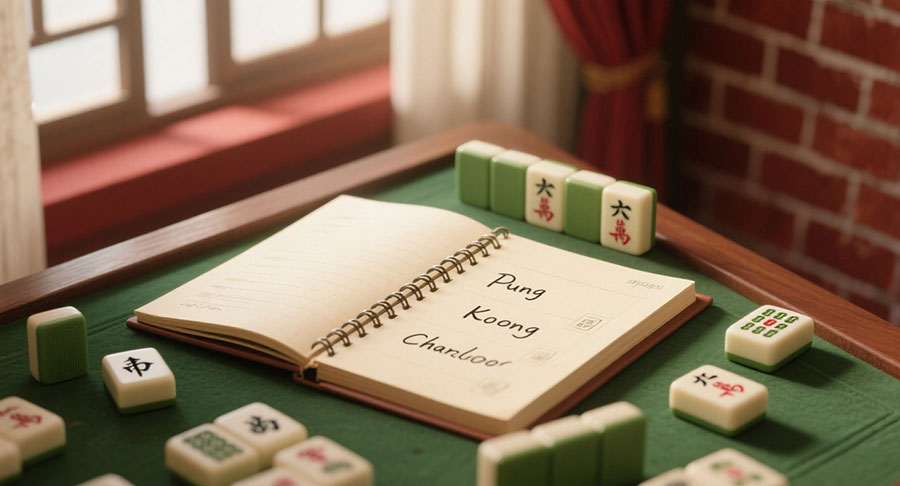
Charleston: The mandatory six-pass tile-passing ritual at the start of every American mahjong hand. Three mandatory passes (right, across, left) followed by up to three optional passes, plus a final courtesy pass across the table.
- East: The starting dealer. Sits with back to the room entrance. Rolls dice to break the wall, deals tiles, and starts the Charleston.
- South, West, North: The other three seat positions, fixed relative to East. South is East’s right, West is East’s left across the table, North is East’s left.
- NMJL card: The annual rulebook from the National Mah Jongg League. Lists all valid winning hands, point values, and core rules for the year.
- Joker: One of eight wild tiles in an American set. Wild inside pungs, kongs, quints, but never in pairs. A discarded joker is dead — never callable.
- Flower: One of eight tiles representing the four seasons (Spring, Summer, Autumn, Winter) with two copies each. Wild inside any block including chows, but never in pairs.
Block and Tile Terms
Pung: Three identical tiles. Can use 0, 1, 2, or 3 jokers (one real plus two jokers works, three real works, etc.). Pungs are the most common building block in American mahjong. Callable from discards — call "pung" and expose on your rack.
Kong: Four identical tiles. Works like a pung but requires four tiles. In practice, kongs are often jokerless (four real tiles) because you only have four physical copies of each tile anyway. Jokerless kongs get bonus points.
Quint: Five identical tiles — unique to American mahjong. Requires either two real tiles plus three jokers, or one real tile plus four jokers. You cannot have three or more real tiles in a quint because there are only four physical copies of each tile.
Pair: Two identical physical tiles. Can never contain jokers — a pair of one real plus one joker is invalid. Every winning hand needs exactly one pair. More than one pair means your hand is dead.
Chow: Three consecutive tiles in the same suit — three, four, five bams, for example. Only suits form chows; winds and dragons are never part of sequences. Flowers can substitute in chows, jokers cannot.
- Craks, Dots, Bams: The three suit tile families. Craks have red numerals with characters, Dots have circles, Bams have bamboo sticks. Each suit has numbers one through nine, four copies each.
- Winds: Sixteen tiles representing four compass directions — East, South, West, North. Four copies of each. Important for seat positions and as block building materials.
- Dragons: Twelve tiles in three colors — Red, Green, White. Four copies of each. Used in many card lines alongside winds.
- Suit restriction: A card-line rule requiring all tiles to be of one suit, or excluding certain suits. Winds and dragons always count as "wild suits" for restriction purposes.
- Point value: The number printed at the end of each NMJL card line — 25, 50, 100, 150, 200, 300, 500. The base payment for winning on that line.
Game Action Terms
Call: Announcing you need a freshly discarded tile to complete a block or win. Say "call," "pung," "kong," or "quint" as appropriate. You may call before the next player finishes racking their draw — the three-second window.
Expose: Place a called block on top of your rack so everyone can see it. Exposed blocks are public information that opponents use to guess your target card line.
Joker swap: On your turn, before drawing, you may take a real tile from your concealed rack and exchange it for a joker inside one of your exposed blocks. Keeps your hand flexible.
Self-pick: Drawing your winning tile from the wall rather than calling it from a discard. Self-pick wins pay everyone double regardless of exposure status.
Mah Jongg: The phrase you say when your hand matches a valid card line. Announce clearly, then expose your entire rack for verification.
- Draw: Take one tile from the wall on your turn. Wall drawing goes clockwise along the wall, even though play order is counter-clockwise.
- Discard: Remove one tile from your hand after drawing, naming it aloud (e.g., "five bam"). Place it face-up in the discard pile in the center of the table.
- Pass: The Charleston action of selecting three tiles and passing them to the next player in the Charleston direction. Six passes total in a full Charleston.
- Blind pass: A Charleston variation on the third mandatory pass (and sixth optional pass). You may keep up to two of the three tiles you just received, and pass fewer of your own as long as total passed stays at three.
- Courtesy pass: The final Charleston step. Two players across the table agree on zero to three tiles to exchange one last time before play begins.
Outcome and Penalty Terms
Dead hand: A hand that becomes invalid mid-game and cannot win. Common causes: passing a joker in the Charleston, calling a tile for a concealed-only line, calling for a pair, wrong number of tiles. Dead-hand players sit out the rest of the hand.
Wall game: The result when the wall runs out of drawable tiles and no one has won. No payments change hands, the deal passes to the next seat, and a new hand begins.
False Mah Jongg: Declaring Mah Jongg with an invalid hand. Penalty: pay every other player the full base value of the hand you incorrectly claimed. Designed to discourage rushed declarations.
Dealer: The player who breaks the wall, deals tiles, and starts the Charleston. East is the dealer for the first hand. The deal passes one seat to the right after every hand (whether a win or wall game).
- Three-second window: The brief period after a discard during which anyone may call that tile. If the next player has already racked their next draw and discarded, the window is closed.
- Wild tile: Any tile that can substitute for another tile inside blocks. Jokers are wild inside pungs/kongs/quints; flowers are wild inside any block including chows; suits are wild within their own suit family (not wild across families).
- Last two tiles rule: The second-to-last tile of the wall and the very last draw are still valid winning tiles even if the wall is about to run out. A win on either of these tiles resolves normally.
- Running balance: A scorekeeping method where each player starts at zero and adds or subtracts payments after every hand. Final balances at the end of the session determine settlement amounts.
- Verification: The moment after Mah Jongg is declared where the entire table checks your hand against the specific card line you are claiming. Any mismatch invalidates the hand.
Frequently Asked Questions
Where does the word "mahjong" come from?
It comes from Chinese "mahjongg" (literally "sparrow," after the birdlike sound of tiles being shuffled). The game originated in the Qing dynasty of China, possibly in the 19th century, before spreading internationally in the 1920s.
Why "pung" and not "three of a kind"?
Like many games, mahjong developed specialized terminology to make communication faster at the table. Saying "pung" is quicker than "three of a kind" and instantly tells everyone you are exposing a block, not calling for a win.
What is the difference between a quint and five of a kind in poker?
In poker, five of a kind is impossible (you only have four of each card). In American mahjong, quints work because two copies of each tile plus three jokers gives you the five needed. Quints pay very well because they are hard to build.
Why do we call it "the Charleston"?
The ritual was named after the city of Charleston, South Carolina, where the modern version of the game (including the six-pass Charleston) was formalized by white American socialites in the 1920s. Before that, passing rituals varied by region.