American Mahjong Tiles: All 152 by Family — Suits, Winds, Dragons, Flowers and Jokers
An American mahjong set contains exactly 152 playable tiles divided into five families: suit tiles, winds, dragons, flowers, and jokers. Every beginner should be able to identify each family instantly before their first game — misidentifying a dragon as a wind or a flower as a suit tile leads to dead hands and confusion. This guide walks you through every family, shows how many copies of each tile you have, and points out the visual mix-ups that trip up new players.
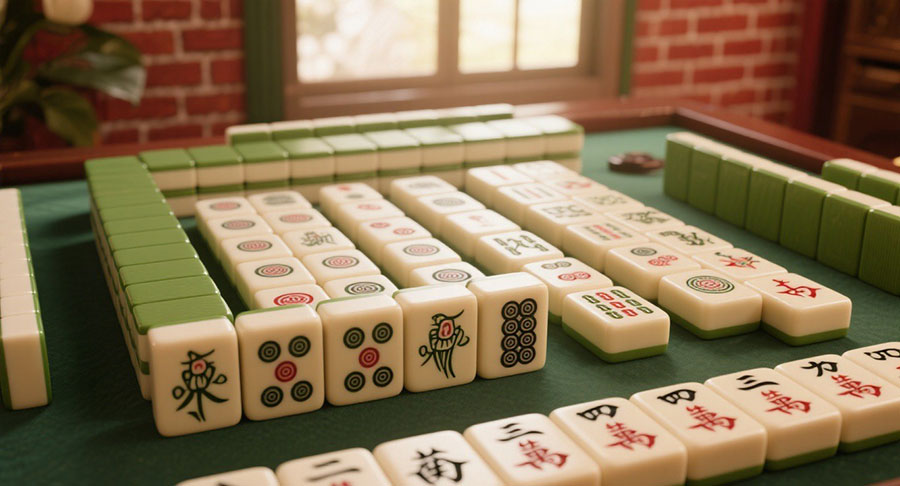
The Three Suits: Craks, Dots and Bams
Suit tiles are the largest family — 108 tiles total, 36 per suit, numbered one through nine. The three suits are: Craks (sometimes called characters), which feature Chinese numerals one through nine in red ink with a character symbol. Dots, which show circles from one large circle to nine small circles arranged in rows. And Bams (short for bamboo), which show bamboo sticks — one stick, two sticks, up to nine sticks arranged vertically.
Each suit has exactly four copies of each number. That means there are four "one crak" tiles, four "two crak" tiles, and so on through four "nine crak" tiles — 36 tiles per suit times 3 suits equals 108. Every tile except jokers and flowers has exactly four physical copies in the set.
Beginner mix-ups: one crak and seven crak look visually similar if you are not reading carefully — both have a red character and a number, seven has additional decoration that can confuse new eyes. One bam and two bam can blend together at a glance since both feature vertical lines of bamboo. Dots are usually the easiest suit to read because the circle count is unambiguous.
All three suits are treated as equivalent for card-line purposes — there is no inherent hierarchy. A pung of three craks is worth the same as a pung of three dots or three bams. However, many card lines specify "all one suit" or "bams only" or similar restrictions, so pay close attention to which suits your target line allows.
The Wind Tiles: Four Directions
Sixteen wind tiles represent the four compass directions — East, South, West, North — with exactly four copies of each direction. The visual design varies by manufacturer, but the most common style shows a simple Chinese character for each direction with a background color to distinguish the tile family from suits and dragons.
Winds play two roles in American mahjong. First, they determine seat positions: East is the starting dealer, South sits to East’s right, West sits directly opposite East, and North sits to East’s left. Second, winds are building blocks for many card lines — "all winds," "two pungs winds two pungs dragons," and similar patterns appear on every NMJL card.
Beginner mix-ups: East and West can look similar if the characters are simplified on a budget set. North and South also share visual elements. Get in the habit of saying the direction aloud when you expose a wind pung so everyone at the table is clear about which one you have. Misidentifying a wind during Mah Jongg verification is embarrassing and potentially costs you the win.
The Dragon Tiles: Three Colors
Twelve dragon tiles in three colors — Red, Green, and White — with exactly four copies of each. The visual design for Red dragons is a red Chinese character meaning "center" or "middle." Green dragons show a green character meaning "fortune." White dragons vary widely — some manufacturers use a plain white tile with no marking, others show a simple circle or frame.
Dragons are also called "zhong-fa-bai" in Chinese mahjong circles, from the three characters on Red, Green, and White respectively. In American mahjong they function exactly like winds — they appear in block-based card lines, they can be part of all-dragon hands, and they mix with winds in lines that say "winds or dragons."
Beginner mix-ups: White dragons are the trickiest because many sets show them as blank white tiles. New players sometimes mistake them for spare tiles or discards left in the center. Get to know how your set marks white dragons before the game starts — most manufacturers now put some minimal marking on them even if it is just a thin frame.
Flowers and Jokers: The Two Wild Families
Eight flower tiles represent the four seasons — Spring, Summer, Autumn, Winter — with two copies of each season. Flowers are wild inside blocks (pungs, kongs, quints, chows) but cannot be used in a pair. They are the only tiles other than jokers that stand in for missing tiles.
Eight jokers are fully wild inside pungs, kongs, and quints only — they cannot substitute in chows and absolutely cannot be used in a pair. Jokers also have a unique dead-discard rule: once discarded, never callable. This makes jokers simultaneously the most powerful and most dangerous tiles in the set.
Total tile count: 108 suits plus 16 winds plus 12 dragons plus 8 flowers plus 8 jokers equals exactly 152. Some sets include extra blank tiles as spares (often 4 to 8 extras), but these never enter play — they sit in the box for replacing lost tiles. Always verify you are playing with exactly 152 tiles before starting a hand.
Purchasing a new set? Pay attention to the tile material. Budget sets use pressed plastic that wears down within two years of weekly play. Mid-range sets use solid acrylonitrile butadiene styrene (ABS) plastic or melamine — lightweight, durable, and the standard for most players. Premium sets use natural stone, hand-painted ceramic, or even mother-of-pearl inlays for heirloom-quality beauty.
Engraving vs printing: engraved tiles have the design carved into the surface and infilled with colored paint. They survive decades of table banging and occasional drops. Printed tiles have the design applied to the surface with ink that wears off within 12 to 18 months of regular play. If you are investing in a set you will use for years, engraved is non-negotiable.
One beginner tip: before your first game, take five minutes to sort all 152 tiles by family. This helps you internalize the visual differences between suits, winds, dragons, flowers, and jokers. When a game runs fast and you need to read a discard instantly, muscle memory from sorting pays off.
One common purchasing mistake: some budget sets from overseas come with the wrong number of tiles — 144 instead of 152. Before buying, count the tiles or verify the listing explicitly says "American mahjong, 152 tiles with 8 jokers." If the description mentions "Chinese set" or "144 tiles," it will not work for American play and you will end up disappointed.
Frequently Asked Questions
Are all American mahjong tiles the same size?
Standard American tiles are roughly 1.2 to 1.3 inches tall (30 to 33 mm), 0.9 inches wide, and 0.7 inches thick. Travel sets use 0.8 to 1 inch tiles. Beginners should avoid mini tiles for their main set — they are harder to read and rack during long games.
Do flowers count as jokers?
Flowers and jokers are both wild inside blocks, but flowers are slightly different. Flowers can also substitute in chows (three, four, five bams with a flower as the four bam works), while jokers cannot. Both flowers and jokers cannot be used in pairs.
Why are there eight jokers and not more?
The NMJL standardizes American mahjong at eight jokers per set. More jokers would make hands too easy to complete and slow the pace of strategy. The current number (8 jokers out of 152 total tiles) gives a good balance between flexibility and skill.
Should I buy engraved or printed tiles?
Engraved tiles have the design carved into the tile surface and filled with paint — they survive decades of weekly play. Printed tiles have the design applied to the surface with ink, which wears off within a year of regular play. Engraved is always the better long-term investment.