Best Mahjong Mats for American Mahjong (2026)
A mahjong mat is the cheapest upgrade with the biggest payoff. Tiles land softly instead of clattering, racks stop sliding when somebody pushes a wall, and the dining table survives the evening without a scratch. A mat also does something less practical but just as real: it tells everyone at the table that this is a game worth setting up for. Here is how to choose one.
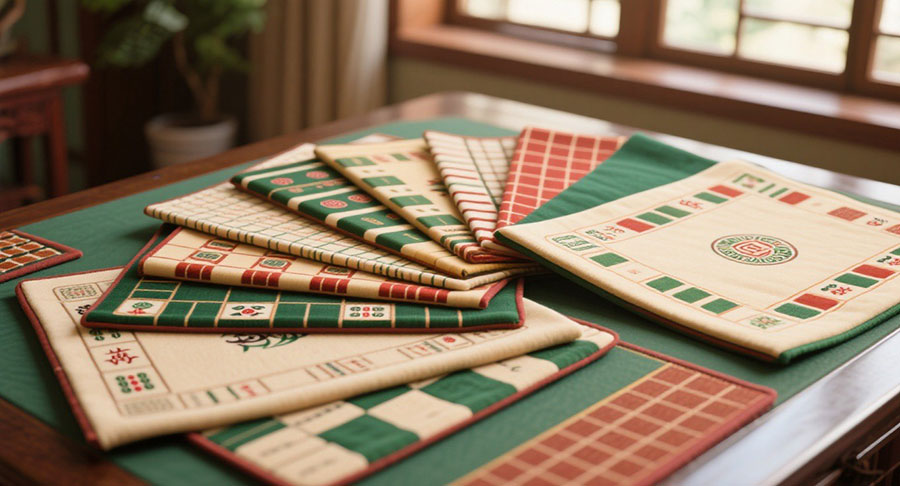
Why a Mat Changes the Game
Mahjong is a loud game by nature. Forty pounds of plastic gets shuffled, stacked, pushed and knocked over for three hours, and bare wood amplifies every collision. Neoprene and felt absorb most of that, so conversation stays possible and nobody flinches when a wall collapses.
Grip matters just as much. Racks have smooth feet, and on a polished table they slide away from a pusher every time. A mat gives them something to bite into, which keeps each player’s wall square and makes the whole game look tidier. Then there is protection: varnish, glass and veneer all lose to ceramic tiles eventually.
Player Mats Versus Full-Table Toppers
Mats come in two shapes. Individual player mats are roughly 13 to 14 inches square, one per person, and they sit under each rack and wall segment. Full-table toppers cover the entire playing area, usually 32 to 35 inches square, and are laid down once before the game starts.
- Player mats: cheaper, easier to store, and they work on any table shape.
- Toppers: fastest setup and the most polished look, especially on a dedicated game table.
- A topper needs a table at least as large as the mat, so measure the diagonal rather than only the width.
- Player mats can double as placemats when space is tight.
Materials Compared
Neoprene wins for most households because it combines grip, silence and washability at a reasonable price. Felt is the traditional choice and the cheapest way to soften a table, but it pills and traps crumbs. Leather looks sophisticated and wipes clean, though it is noisier than fabric and can be slippery under a heavy rack.
| Material | Feel | Noise | Care | Best for |
|---|---|---|---|---|
| Neoprene | Soft, grippy | Very quiet | Machine wash cold, air dry | Most home games |
| Felt | Warm, traditional | Quiet | Spot clean, vacuum | Budget setups |
| Suede or velour | Luxe, soft | Quiet | Gentle spot clean | Gift-worthy sets |
| Faux leather | Firm, wipeable | Moderate | Wipe with a damp cloth | Multi-use tables |
| Vinyl | Smooth, thin | Loud | Wipe clean | Kids and rentals |
Neoprene in Detail
Neoprene mats use the same construction as a quality mousepad: a fabric surface bonded to a rubber backing. The fabric gives tiles a soft landing and enough texture that racks stay where you put them, while the rubber base keeps the mat from creeping across a table during a long game.
Thickness matters. Around 2 to 3 millimeters is plenty for quiet play; thicker mats feel plusher but can make racks sit slightly unevenly at the edge. Check that the edges are stitched or heat-sealed, because cheap neoprene delaminates at the corners after a few washes.
The Non-Slip Backing Test
Before you trust a mat, put it on your actual table and push a loaded rack across it. If the mat slides with the rack, the backing is decorative and the product will disappoint you weekly. Rubber or textured foam backs hold; smooth fabric backs and thin vinyl do not. For toppers, a non-slip base is essential, because a 35-inch mat has enough surface area that a wall push can send the whole thing drifting. A quick check at home: dampen a finger, touch the back, and feel for tackiness. If it feels like a plastic bag, keep looking.
Thickness, Edges and Finish
Thin mats roll easily but offer little cushioning, and thick mats feel luxurious while raising the playing surface, which matters if your racks have short feet. Pay attention to the edge: bound or stitched edges survive handling, while raw cut edges fray within a season. Printed designs should be dye-sublimated into the fabric rather than applied as a surface layer that peels after a few cleanings.
Color and Design
Mats are the most visible style decision in your kit, and the color should serve the tiles. Cream, sage and muted reds make ivory tiles pop without competing with them; busy photographic prints look festive in photos and visually noisy after twenty minutes of play. If you host often, a solid neutral mat with one accent color reads as intentional and photographs beautifully for game-night pictures.
Care, Storage and Travel
- Roll, never fold: creases in neoprene become permanent valleys that catch tiles.
- Wash with cold water and a drop of mild soap, then air dry flat; heat shrinks the backing.
- Vacuum felt weekly if you snack at the table.
- Store mats in the tube they came in, or in a cardboard poster tube.
- For game nights away from home, roll two player mats and a dice cup into one bag.
Budget Expectations
Individual neoprene mats start around $10 and climb to $30 for coordinated sets of four. Full-table toppers generally run $35 to $90 depending on size and finish, and quilted or leather versions can pass $100. A plain felt cover costs less than $20 and handles most of the noise control, though it will not improve grip or protect against spills as well as neoprene.
Alternatives and DIY Options
If you already own a large cutting mat, it works surprisingly well: dense, grippy and easy to wipe. A thick cotton quilt or a yoga mat is a fine stopgap for a first game night, as long as nobody drags a rack across it. Avoid tablecloths with fringe, deep embroidery or a loose weave, because tiles snag and walls lean. Whatever you use, make sure the surface is flat and large enough for four racks with room to build walls.
Mats for Small Spaces and Travel
If your game moves between homes, four player mats beat one topper. Each player rolls their own mat into a bag, and the host does not need a dedicated table. In an apartment, a topper that rolls around a core stores behind a sofa far more easily than a folding table, and it turns a kitchen table into a game surface in under a minute. Confirm the rolled diameter before buying, because some 35-inch toppers roll into a cylinder too fat for a closet shelf, which is the sort of detail that only matters after the second game night. Travel mats are thinner and lighter, and they crease if packed flat, so roll them with the fabric side out.
Complete the Table
A mat is one part of a comfortable setup. Pair it with racks that push smoothly, a scorepad and the right set. For the full picture, see our table setup ideas, and read mahjong table etiquette before you host your first night; it covers the small habits that make a shared table pleasant.
Frequently Asked Questions
Do I really need a mahjong mat?
You can play without one, but a mat is the cheapest improvement most players ever make. It quiets the tiles, stops racks from sliding and protects the table surface. If your table is polished wood or glass, a mat pays for itself the first time a stack falls over.
What size mat fits four players?
Four player mats at 13 to 14 inches square work for almost any table. If you prefer one surface, choose a topper of at least 32 inches square, ideally 35, so all four racks and the walls fit with a little breathing room in the middle.
Can I wash a neoprene mahjong mat?
Yes. Machine wash cold on a gentle cycle, then air dry flat; never put neoprene in a dryer, because heat warps the rubber backing. For routine cleaning, a damp cloth with mild soap is enough, and it should be dry before you lay tiles on it.
Felt or neoprene for a beginner?
Neoprene. Felt is cheaper and traditional, but it sheds fibers, holds crumbs and offers much less grip. Neoprene costs a little more, washes clean and keeps racks planted, which is exactly what a beginner notices in the first ten minutes of play.
Will a mat work on a glass table?
Yes, and it is strongly recommended. Glass is scratch-resistant but not scratch-proof, and it amplifies every tile click. A mat with a rubber backing protects the surface and prevents the sliding that makes glass tables frustrating for wall building.
How do I stop the mat from sliding?
Choose a mat with a rubber or textured foam backing and check that your table is clean and dry before laying it down. If your topper still creeps, a few strips of removable grip tape under the corners will hold it without marking the table.
Affiliate disclosure: As an Amazon Associate, we earn from qualifying purchases at no extra cost to you.
Compare prices on Amazon →