How to Build the Mahjong Wall — Step-by-Step With Pictures
The wall is the part of American mahjong that looks like ritual and is actually bookkeeping. Every hand uses every tile in the set, so the wall has to hold exactly 152 tiles before the first die is rolled: four walls of 19 stacks, each stack two tiles high. Get that count right and everything downstream takes care of itself, from the deal to the moment the wall runs dry. Get it wrong and you will discover the problem twelve turns later, when somebody reaches for a tile that should not exist.
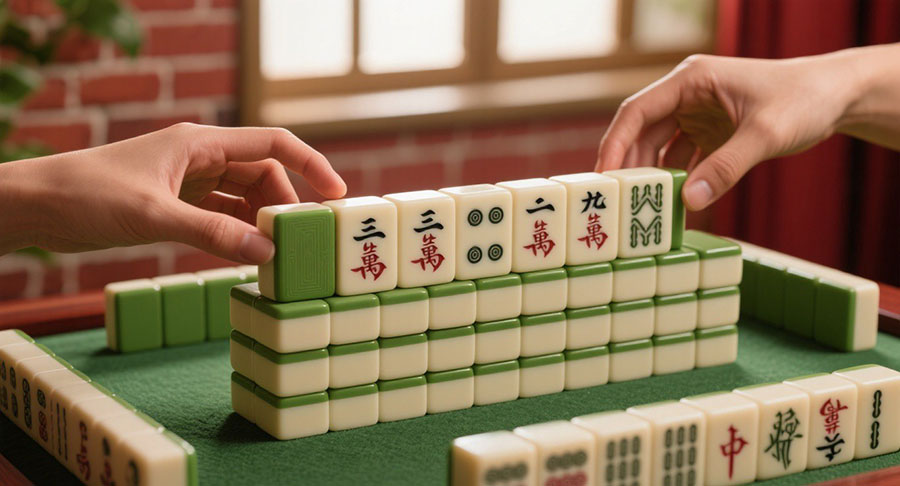
Why the Count Is Fixed
American mahjong uses all 152 tiles every hand. There is no dead wall, no replacement draw and no kitty set aside for later. That gives you one equation and no room to improvise: four players, 19 stacks each, two tiles per stack, 4 times 19 times 2 equals 152. If your table can build that square, the hand is structurally correct before a single tile is dealt.
An 18-stack wall means the table is short 38 tiles and the deal will not reach the last player properly. A 20-stack wall looks harmless and then produces a long game where the wall outlasts everyone's patience and the discard pile becomes the real battlefield. Both errors are common in new groups, and both are caught in ten seconds by counting stacks instead of eyeballing the row.
What 19 Stacks, Two High Looks Like
Picture one stack as two tiles lying flat, face down, one directly on top of the other. Nineteen of those stacks in a straight line is a wall roughly the width of a dinner plate times three, sitting just inside the table edge in front of your rack. The top faces should be perfectly level across the whole row; if one stack sits proud, it was built with three tiles or the table has a dip.
The two-high convention is American, not universal. Chinese mahjong often builds walls one tile high or in a different shape, and players arriving from that background sometimes build flat rows out of habit. Two high is better here because stacks hold together during the deal, dealing four at a time comes off cleanly in pairs, and the wall stays stable when somebody bumps the table reaching for a snack.
Building Your Own Wall, Stack by Stack
After the wash, sit at your rack and pull tiles toward you two at a time. Place the pair face down and slide the next pair tight against it. Keep your building line straight by aligning the front edges with the table edge or the mat seam, and build away from yourself rather than sideways, so the row grows evenly in both directions from your center.
Count in fives: five stacks, ten, fifteen, then four more. Counting nineteen individual stacks invites a miscount at exactly the moment someone asks you a question. When you finish, run a finger along the top of the row and check that every stack has two tiles; a single tile lying loose on the table means one of your stacks is short.
Keeping the Square Honest
The four walls should meet at the corners with no gaps and no overlap. If your wall ends two inches short of your neighbor's, one of you is a stack off or the racks are not parallel. Corners that touch also make the break easier to see, because the opening you push is visually obvious against a continuous square.
Never stack extra tiles on top of a finished wall, and never park a drink on the wall's edge. Both habits end the same way: a cascade of face-up tiles, a dead hand and an argument about who saw what. If you need space, push your rack back further; the wall is the one thing on the table that must stay untouched until the dice are rolled.
The Pre-Roll Checklist
Before East touches the dice, the table should be able to answer four questions without counting anything twice. Does each wall have 19 stacks? Are all stacks two tiles high? Are there any tiles left in the middle? Do the corners meet? If the answer to any of those is no, fix it now, because after the roll the table is committed and a rebuild becomes a scene.
One more check costs nothing: confirm that the set is complete. Counts of 152 are easy to verify when the walls are square, because a missing tile leaves a visible hole in somebody's row. If you find a hole, search the floor and the tile bag before redistributing tiles, since a tile under a chair will otherwise reappear mid-hand and derail the game.
Rolling the Dice to Find the Wall
East rolls both dice and adds the pips. Starting with East's own wall as number one, count clockwise around the table and repeat if the total exceeds four. A roll of 5 lands back on East, 6 on South, 7 on West, 8 on North, and 12 wraps around to North again. The wall that comes up is the only one that gets opened.
Announce the total and the wall out loud before counting stacks. Beginners often roll, count silently and then break a wall two seats away from where everyone else counted. Saying 'seven, West' takes one second and prevents the single most common wall error at casual tables. If two players disagree after the fact, the dealer's announced count stands.
Counting Off and Pushing the Break
The player who owns the chosen wall now counts the same number of stacks off from the end of their wall. Stack one goes to the right, two to the right, and so on until the count is reached, then push those counted stacks outward to open a gap. The tiles that were pushed become the break, and the two ends of that gap are where the deal begins.
Direction conventions vary between groups. Some count from the wall owner's left, some from the owner's right, and some count around the square rather than along the wall. None of that matters as long as the table agrees before the first hand. What does matter is that the pushed stacks stay in order and are not folded back into the wall, because they are the source of every draw for the rest of the hand.
Dealing and Drawing From the Break
The deal starts at the break and moves around the table, four tiles at a time, three times around, then East takes two from the break and everyone else takes one. From that point the wall is consumed from the same opening, one tile at a time, moving along the wall in the same direction the deal traveled. The wall shrinks from a single point rather than from all four sides.
Play order and wall order run in opposite directions, which is the detail that confuses new players most. Turns pass to the right, while tiles come off the wall clockwise, so the opening travels around the square in the opposite direction from the players. If you remember nothing else about the wall, remember that the break is both the start of the deal and the mouth of the draw pile.
When the Wall Runs Out
If the last tile is drawn and nobody has declared Mah Jongg, the hand is a wall game. Nobody wins, nobody scores, and no one pays anyone. The tiles go back to the center, everyone washes, and East passes the deal to the right before the next hand. A wall game is not a failure; it is a normal outcome that happens more often than beginners expect.
A wall game also tells you something useful. If the wall emptied while three players were close to a hand, the table was playing too slowly or holding too many unconnected tiles. If it emptied while nobody was close, the deal was probably unusually scattered and the next hand will feel completely different. Either way, reset calmly and keep the rotation moving. The full rules for a draw are in wall games explained, the table setup that precedes all of this is in game setup, and the deal that follows the break is in dealing American mahjong.
Fixing a Bad Wall Fast
- One wall is short by a stack: find the loose tiles in the middle and rebuild that wall before rolling.
- One wall has 20 stacks: pull the extra pair out and add it to the middle, then recheck all four walls.
- Tiles remain in the center after all four walls are built: someone is short. Recount every wall rather than guessing which one.
- A stack falls during the deal: rebuild that section and continue if the count is intact, otherwise redeal the hand.
- The wrong wall was opened: stop immediately, return every dealt tile to the center and start over from the correct break.
- The break was pushed on the wrong side: same fix. Return the tiles and rebreak; a misdirected break invalidates the draw order.
Frequently Asked Questions
How many stacks does each player build?
Exactly 19 stacks, two tiles high. Four walls of 38 tiles each gives the full 152-tile set.
Why do American walls stand two tiles high?
Two-high stacks are stable, deal cleanly in pairs of four and are the standard American convention. Flat walls belong to other mahjong styles.
Can we reuse last hand's wall?
No. The wash and the rebuild are the shuffle. Reusing a wall means the same tiles sit in the same order for two hands.
What does pushing the break mean?
The owner of the chosen wall counts off the dice total in stacks and pushes those stacks outward, opening a gap that becomes the deal and draw point.
What if the dice total is more than four?
Keep counting clockwise and wrap around. Five is East again, six is South, seven is West and so on.
Is a wall game a loss?
No. A wall game is a draw. Nobody scores, the deal passes right and the next hand starts fresh.
Do we count stacks before or after rolling?
Before. Every wall must be verified at 19 stacks before East rolls, so a bad wall is fixed while a rebuild is still cheap.