Printable American Mahjong Cheat Sheet for Beginners (Free)
Every beginner table hits the same five minutes: someone asks whose turn it is to pass, someone else asks whether a joker can be called, and the game stalls while four people squint at the NMJL card. A one-page cheat sheet fixes most of that. This is not a rulebook, and it is not a substitute for learning the game properly. It is a paper tool — printed, laminated, and parked exactly where your eyes already go during a hand. What follows is how to print it, where to place it, how to teach with it, and how to retire it once the rules finally live in your head.
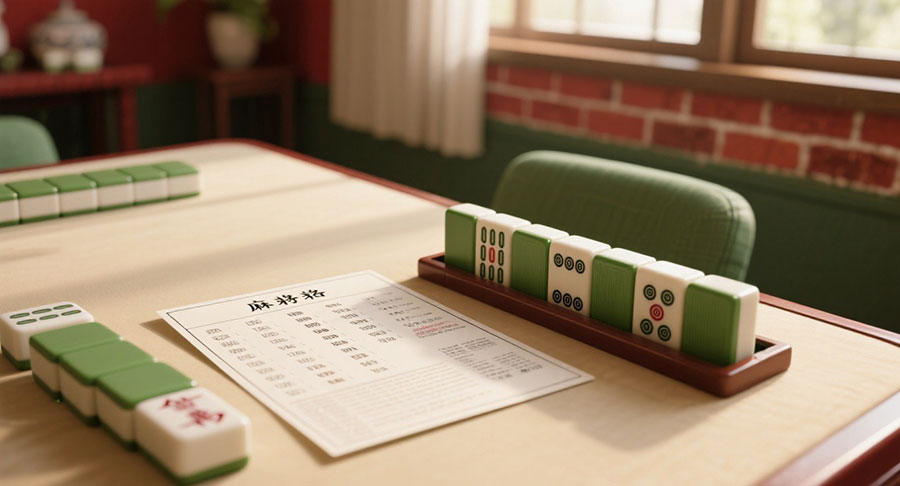
Free printable: This guide as a one-page PDF — print it and tuck it under your rack.
Download the PDF ↓What the Sheet Is and Is Not
The sheet is a quick-reference card for decisions you make dozens of times a night: can I call this tile, can I pass this joker, who pays whom, and what order do the Charleston passes go in. It condenses those into short lines you can read in two seconds without losing your place in the hand. It is deliberately shallow. It does not explain why the rules exist, how hands are built, or how to choose a hand from the card. Treat it as the index, not the book.
That distinction matters because a cheat sheet used as a rulebook creates bad habits. Players start reading it mid-turn, holding up the table while they scan for an answer that a two-minute explanation would have settled permanently. The best use is to answer a question once, out loud, and then point at the sheet as the reminder. If you find yourself reading the same line every week, that is the line you have not actually learned yet — go read the long version.
Where to Put It on the Table
Placement is the whole design. The sheet belongs beside your rack, angled toward you, not under it and not across the wall. Tucked under a rack it disappears the moment you need it; laid flat in the middle it becomes clutter that blocks the wall and hides discarded tiles. Tape it to the table edge in front of each seat, or lean it against the front of the rack if your rack has a lip. If your mat has a printed border, that border is the natural home, and a strip of removable tape keeps a laminated sheet from sliding.
Your First Four Games: A Progression
The progression matters because a cheat sheet that stays in the same place forever becomes a crutch. Each game removes one layer of support, and by the fourth session the table is playing from memory with the sheet as insurance. Groups that skip the progression tend to still be reading the payment rules in month six, which slows every single hand. The full game flow is in the beginner's guide.
- Game one: leave it face-up in front of each player and read the pass sequence aloud at the start of every hand. New players need the sequence spoken, not just printed.
- Game two: flip it face-down but keep it within reach. Let people pick it up only when the table agrees the hand is stuck.
- Game three: keep one shared copy in the center, face-down, for the whole table. Nobody owns it, and anybody may consult it once per hand.
- Game four: keep it in the room but off the table. If nobody touches it, you have graduated.
Printing It Properly
Print at 100 percent scale, never fit-to-page. The sheet is laid out to be read at arm length, and shrinking it to fit a narrow margin defeats the purpose. US Letter is the default; if you are in a country that uses A4, the layout still works because the text is short-line, but check that nothing clips at the bottom before you print twenty copies.
One copy per player is the minimum. A single shared copy always ends up in one person's corner, and the whole point is independent glancing. For a regular table, laminate two: one for the table, one for the teaching kit. Lamination survives spilled drinks, and it lets you circle problem lines with a dry-erase marker.
Teaching a Brand-New Player With It
Hand the sheet to the new player before the first deal, not after the first confusion. Walk through three lines only: the Charleston order, what may be called, and who pays on a win. Everything else can wait. A new player who receives the entire sheet at once reads none of it; a new player who receives three lines remembers them because the next hand depends on them.
Then play one hand open, with the new player's tiles face-up on the rack and the sheet beside it. When a decision comes up, ask them to find the answer on the sheet rather than telling them. This takes about ninety seconds longer per decision the first time and roughly zero extra time by the third hand. The sheet becomes a tool they use rather than a handout they lose. The longer method is in how to teach American mahjong.
What the Sheet Leaves Out on Purpose
There is no hand list on the sheet, no scoring table beyond the payment basics, and no strategy. That is deliberate. The card changes every spring, so any hand reference printed on a cheat sheet is obsolete within a year. Payment rules are stable enough to print; specific hand values are not. Strategy is the opposite of a quick reference — it needs paragraphs, not arrows.
The sheet also omits etiquette, which is a mistake people notice at their first shared table. Passing a tile with a comment, slamming a discard, or peeking at a neighbor's rack are all covered elsewhere, and a single line on the sheet cannot carry the nuance. If your group is new to the game, read an etiquette guide together once before the first night rather than expecting paper to teach manners. The deeper rule explanations live in American mahjong rules.
Five Ways People Misuse It
- Reading it during their own turn instead of between hands, which stalls the table for everybody.
- Treating it as authoritative when a host's house rule differs, then arguing from paper instead of asking.
- Leaving it flat in the center, where it hides discards and gets picked up with the wall.
- Printing at 80 percent to save paper, then complaining that the print is too small to read.
- Handing a fresh copy to a guest every week, which guarantees nobody learns the sequence.
Pairing It With the NMJL Card
The card and the cheat sheet do different jobs and should sit on different sides of your rack. The card answers what to build; the sheet answers what you are allowed to do while building it. Keep the card propped at the back corner of the rack so you can scan a line without lifting it, and the sheet flat at the front. If the card itself is new to you, read what the NMJL card is first.
Make It Yours: Annotate a Copy
Laminated sheets take dry-erase marker, and a lightly annotated copy is more useful than a pristine one. Circle the pass sequence if your group forgets it. Star the joker line if a player keeps trying to call a discarded joker. Write your house rule for jokerless bonuses in the margin if your table plays one. Wipe and re-annotate when the group's weak spot changes.
A second copy can be a group project: each player writes the rule they got wrong on the shared sheet at the end of a night. By month's end you have a document of your table's actual mistakes, which teaches better than any generic reference.
When to Retire It
Retire it when a full night passes without anyone reaching for it. That usually happens somewhere between the sixth and twelfth session, depending on how often you play and whether anyone at the table is also learning. Do not throw it away — the sheet goes back into service whenever a new player joins, and a laminated copy lasts years in a drawer.
Frequently Asked Questions
Is the cheat sheet enough to learn American mahjong?
No. It covers the decisions you must make during a hand but skips hand-building, strategy, and etiquette. Use it alongside a full beginner walkthrough and the current NMJL card; the sheet is a memory aid, not a curriculum.
Should I print one per player or one for the table?
One per player for the first few games. A shared copy always drifts to one corner, and the point is for each person to glance without asking. Once the group knows the rules, a single copy in the room is plenty.
Can I laminate it?
Yes, and you should for a regular table. Lamination survives drinks, and it lets you circle problem lines with a dry-erase marker and wipe them off when the group improves.
The print looks small at 100 percent. Can I enlarge it?
Yes. Printing at 11 by 17 makes a good wall poster for a teaching room. Just keep the proportions and do not print a fit-to-page version, which clips the bottom lines.
Does the sheet work for three-player games?
The core lines do, but the Charleston and payment details shift slightly when a seat is empty. Check a three-player guide for the differences and pencil them into the margin.
How often does it need updating?
Rarely. Payment rules and pass order are stable. Hand values and year-specific hands change with each new card, which is why the sheet does not list them — use the card for anything that changes annually.
Is this the same as the Charleston cheat sheet?
No. This one covers the whole turn: calling, jokers, payments, and dead-hand triggers. The Charleston sheet is a dedicated arrow diagram for the passing sequence. Many players print both and keep them back to back.