Printable Mahjong Rules Quick Guide (One-Page Reference)
Someone always says it: teach me. And the moment you start explaining, the table either stalls or you accidentally run a forty-minute seminar while three experienced players check their phones. A one-page rules quick guide solves the logistics problem. You hand it over, sit the new player down, and play a hand open with the page in front of them. The guide does the repetition; you do the encouragement. This is how to use it well, how to print it for different teaching situations, and where it stops being enough.
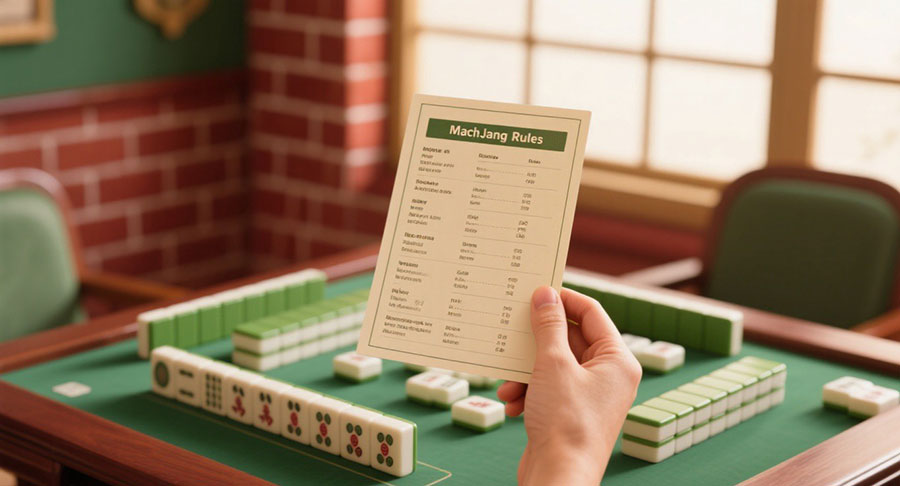
Free printable: The one-page rules reference as a PDF — hand it to your newest player.
Download the PDF ↓Who the Guide Is For
The guide is written for a person who has never touched an American mahjong tile, not for someone who plays Chinese mahjong and needs the differences. It assumes no vocabulary: it names the equipment, lists the deal, draws the Charleston as six arrows, and describes a turn as draw then discard. A player who reads it once should be able to sit down and follow a game without stopping it. Unfamiliar words are collected in the terminology glossary.
It is less useful for a returning player who simply forgot the payment rules, and it is the wrong document for a player who already knows the flow but wants strategy. Match the handout to the person, because a strategy sheet handed to a beginner reads as noise.
The Two-Minute Walkthrough
Start by pointing at the four sections in order rather than reading them aloud. Equipment, deal, Charleston, turn. Say one sentence per section and let them read the detail. Then point at the calling section and the winning section, and stop. That is the entire orientation. New players do not need to understand scoring on the first night; they need to know how a hand starts, how it moves, and how it ends.
Two minutes is not a strict time limit, but it is a good target because attention drops fast when the tiles are already out. If the explanation is running long, the guide is doing its job poorly for that person and you should switch to playing open-handed instead. Demonstration beats description at every level of this game — the page exists to catch what the demonstration missed.
Running a Teaching Table
These five habits cut the teaching load roughly in half. The face-up hand does most of the work because it turns hidden information into a shared diagram; the rest is just keeping the pace honest. A teaching table that plays four hands in an evening teaches more than one that plays a single hand and a long lecture. For a fuller method, read how to teach American mahjong.
- Sit the new player across from you, not beside you, so they see the wall and the discards from the same angle you do.
- Play with everyone's tiles face-up for the first hand only. Two hands open is too many; a full night open is a waste.
- Announce every discard by name for the first three hands, even when playing with experienced players.
- Let the new player make one legal mistake per hand without correction, then explain it between hands.
- Keep the guide on the table, but do not read from it yourself — point at it instead.
Printing Formats That Actually Help
Letter paper, single-sided, one copy per new player is the baseline. Print a second copy double-sided with the beginner cheat sheet on the back, and you have a packet that covers both the flow and the decisions within it. This is the version most hosts keep in a folder by the door, because it costs one sheet per guest.
For a club or a class, enlarge the guide to 11 by 17 and post it at the end of the table where the dealer can see it. At that size it doubles as a visual aid while you narrate. For a recurring group, laminate two copies: paper gets wet, corners get bent, and a laminated copy can be wiped after a night of snacks and drinks.
Walking Through a First Hand
Deal, then pause. Ask the new player to find the deal line on the guide and confirm their tile count out loud. Then run the Charleston slowly, with the sheet visible, one pass at a time. The first pass is the only one that needs explanation; by the third, most people have the rhythm. Announce the end of the Charleston clearly so nobody passes a fourth time out of nerves.
Then play the hand normally, with one modification: when a call is possible, name it and ask whether it is legal before acting. This turns each call into a tiny quiz drawn from the calling section. By the end of one hand, a new player has usually encountered every rule category on the page at least once, which is why this walkthrough beats any amount of reading. The complete version of the same material is in the beginner's guide.
Handling the Questions It Raises
The guide is deliberately terse, so it will raise questions it does not answer. That is fine — the questions are the point. When one comes up, note it, finish the hand, and answer between hands with the long-form rules page open. Answering mid-hand breaks concentration for everybody; deferring for two minutes costs nothing and keeps the table moving.
Two questions come up almost every time: can I call a joker, and what happens if I am short a tile. Both have short answers that also appear on the beginner cheat sheet, which is why the two documents pair so well. Keep the long rules page bookmarked for the third question, which is usually about a specific hand.
What to Skip in Game One
Every one of these gets introduced later, with context. Front-loading them is the single most common teaching error, and it is why some beginners believe the game is complicated when it is mostly repetitive. The guide supports this trimming because it lists the sections in the order you would actually need them.
- Payment amounts beyond who pays whom. Skip the doubling details entirely.
- Jokerless bonuses and other house rules. Add them in week three.
- Concealed hand markers. Let them play exposed hands only.
- Dead-hand penalties. Explain the concept, do not enforce it.
- Running totals across hands. Keep score for fun, not for a ledger.
Using It at a Club or Meetup
At a public meetup, the guide solves a specific problem: you cannot sit with every new person. Print a stack, put them in a folder at the check-in table, and tell newcomers to take one. Announce at the start that the first table is a teaching table and that anyone may join it without knowing the rules. This normalizes being new, which is the real barrier.
Clubs also benefit from a laminated master copy with the local house rules written in the margin — for example, whether jokerless wins double, or how a three-player table handles the empty seat. Print the generic guide, then annotate one copy to match your group.
Keeping It Current With the Card Year
The guide covers stable rules, so it does not need an annual rewrite. What changes is the card, and the card is a separate piece of paper that every player should have anyway. If your guide references hand types by name, check each spring that those names still exist on the new card. NMJL terminology shifts occasionally, and a stale example confuses more than it teaches.
One small maintenance habit: at the start of each new card year, re-read the guide once yourself. You will catch a line you have been misquoting for years, and you will be better at answering the questions it raises.
When the Guide Is Not Enough
The guide stops being enough around the third or fourth session, when the new player can follow the flow but keeps building dead hands. That is a hand-selection problem, not a rules problem, and no one-page reference can fix it. At that point switch to a hands guide and a hand-picking walkthrough.
It is also not enough for a player who wants to play in a tournament or a club with strict rules. Those settings enforce details the guide glosses over, like exact exposure procedures and penalty rules. Use the guide to get someone playing socially, then move them to a full rules reference when they want to play formally.
Frequently Asked Questions
Can a total beginner really learn from one page?
They can start playing from one page, which is the goal. Real understanding comes from playing hands with the page nearby. Expect the first night to feel slow and the second to feel obvious.
Should I give the guide before or after the tiles are out?
Before the first deal, but only briefly. Point at the four main sections, then deal. A long explanation in front of a full table is the fastest way to lose a new player's attention.
What if the new player is left-handed and the table layout confuses them?
It rarely matters, but seat them so their rack and the guide are both on their dominant side. Small comfort adjustments keep people playing longer than any rule explanation.
Do I need the cheat sheet too?
Recommended. The quick guide covers the flow; the cheat sheet covers the in-hand decisions like calls, jokers and payments. Print them back to back and you have a complete beginner packet.
Can I edit the guide for my group?
Yes, but keep the structure. Add your house rules in the margin rather than rewriting sections, so the page stays scannable and matches the generic version everyone else uses.
How long does a first game take with the guide?
About twice as long as a normal hand, so budget ninety minutes for four or five hands. The second session is usually close to normal pace, and by the third the guide is only a backup.